
Robots framed a two-
story house in 8 hours.
And America's biggest builder is betting on it.

Chad Montgomery
Real Brokerage LLC · New Construction Specialist · 20+ Years · 1,000+ Homes Sold
Robots framed a two-story house in about eight hours. That is not a concept video or a trade show demo; it is the stated production capability of a real factory line that America's largest homebuilder just signed a multiyear contract to use. On October 13, 2026, D.R. Horton, the biggest U.S. homebuilder by volume and an Arlington, Texas company, announced a multiyear agreement with Promise Robotics, a Toronto-based construction technology firm founded in 2020, to produce structural framing for more than 1,250 homes, starting near Phoenix, Arizona [1]. I am Chad Montgomery, a Collin County native with more than 20 years in North Texas real estate and a front-row seat to the new-construction market, and I have read every detail of this deal since it landed. Here is what actually happened, how the robots work, what the eight-hour number really means, and what it could mean for markets like ours.
The headline that sounds like science fiction.
Start with the number, because the number is the story. Promise Robotics says its system can assemble the structural framing for a typical two-story, 1,800-square-foot home in approximately eight hours, and its CEO, Ramtin Attar, has told reporters exactly that [2]. Eight hours is one full workday. It reads like publicity fantasy until you remember who signed the contract. D.R. Horton is the largest homebuilder in the United States by volume, closing more homes than any other builder, year after year. When it bets on a technology, the industry pays attention.
And I cannot resist the local angle: D.R. Horton is headquartered in Arlington, Texas, right in the Dallas-Fort Worth footprint [4]. When the biggest homebuilder in America bets on robots framing its houses, that decision is being made from a corporate headquarters in our own backyard, and it says something about where homebuilding is heading across high-growth markets like the ones I serve every day.
The deal: D.R. Horton and Promise Robotics.
Here is what was actually announced on October 13, 2026. D.R. Horton entered a multiyear commercial agreement with Promise Robotics, a Toronto-based construction technology company founded in 2020 that builds AI-powered robotic manufacturing systems for homebuilders [5]. Under the agreement, Promise Robotics will support production of structural components for more than 1,250 homes, with the initial run made up largely of single-family homes near Phoenix, Arizona [1].
The production comes out of a roughly 16,000-square-foot plant in the Gilbert, Arizona area, in metro Phoenix, that is expected to start production in early 2027 [1]. It will be Promise Robotics' first factory in the United States. The company already operates plants in Calgary and Edmonton, Alberta, and says its lines have completed more than 200 builds [5]. In other words, this is not a startup sketching a vision on a whiteboard. The machines have been running in Canada, in real markets and real weather, and this deal scales what those lines already do.
How the robots actually work.
The first question everyone asks me is how a robot frames a house, and the honest answer is: mostly like a very fast, very precise factory crew. It starts with the plans. Promise takes the home designs D.R. Horton already builds and feeds them into its AI-powered platform, which generates the manufacturing models its robotic arms follow [1]. The software goes beyond geometry: it even sets the fastening to match local building codes, so the fasteners, spacing, and connections line up with the rules of the jurisdiction where the home will be built [2]. I love that detail, because code compliance sounds boring until a frame fails an inspection and the whole schedule slips.
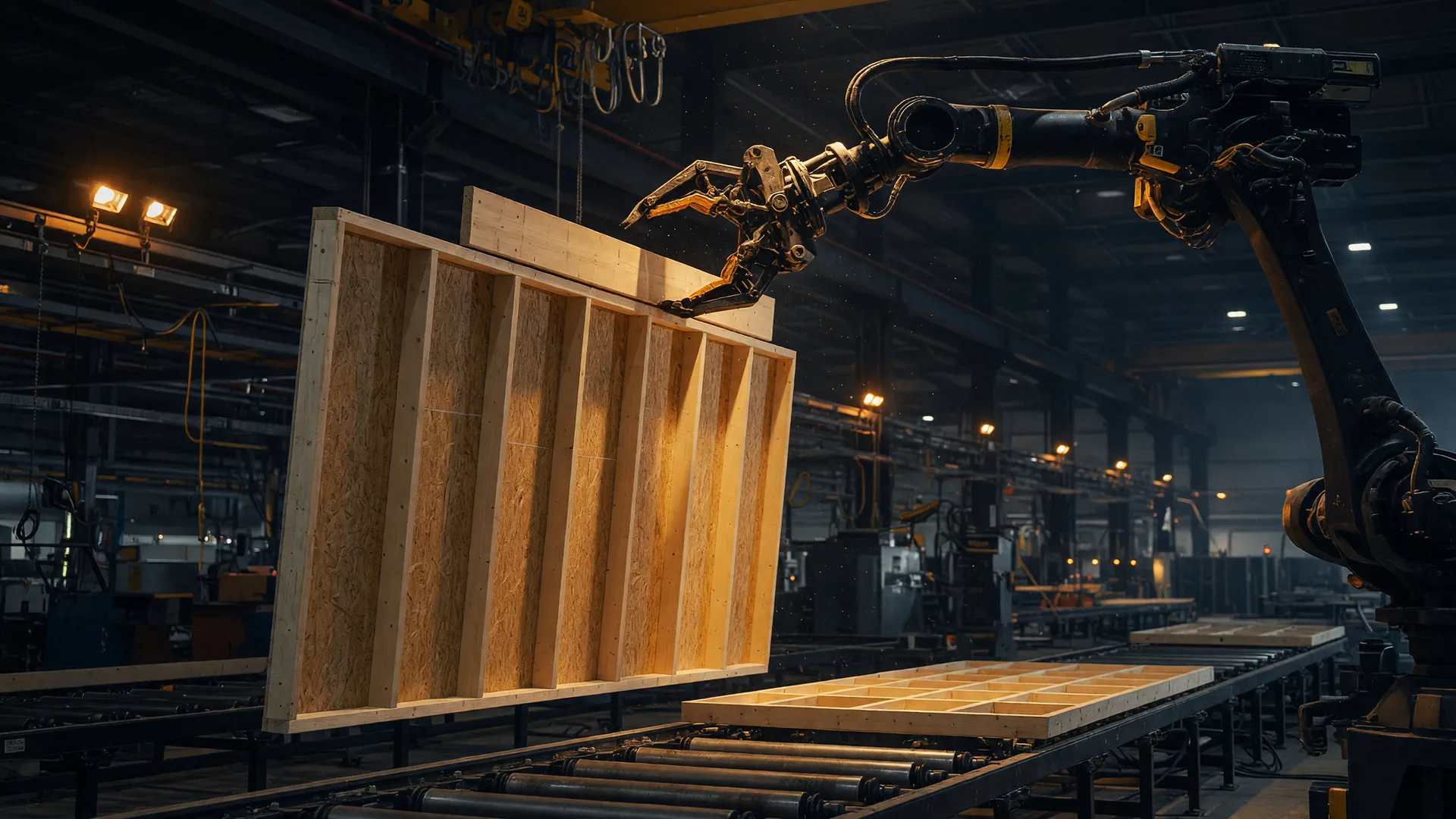
Out of the factory come wall panels and framing pieces, cut precisely, stacked, and staged. Then the trucks roll: panels are transported to the job site, where trained crews assemble them, and the typical house frame goes up on site in about a day [2]. Now picture the difference from how that work has always felt. Traditional stick framing happens out in the weather, crew by crew, nail by nail, chasing the sun, the rain, and the availability of labor. This version moves the precision work indoors, under controlled conditions, and leaves the site crew with the faster, more predictable job of assembly. The people do not disappear from the process. Their work just changes.
What the eight hours really means.
Now the part I want to underline, because headlines can over-simplify: the eight-hour figure is about the framing, not the finished house. Promise Robotics' system can produce the structural framing for that typical two-story, 1,800-square-foot home in about eight hours, and more complex projects, like duplexes, can take two to two-and-a-half days [2]. But framing is just the skeleton. Plumbing, electrical, HVAC, roofing, interior finishing, trim, paint, appliances, and inspections all still happen afterward. A house is not ready for move-in a day after its frame goes up, and nobody involved in this deal is pretending otherwise.
Still, do not let that honesty shrink the story. A complete structural frame in one workday is a massive shift from a hundred years of traditional framing. Framing is one of the most labor-intensive, weather-dependent parts of homebuilding, and it is the place builders feel labor shortages most acutely [3]. Move that work into a controlled factory, and you smooth the labor risk and shorten the cycle time on every home behind it. When a builder goes from a foundation to a standing, framed shell in roughly a day instead of weeks, the whole schedule downstream tightens. That is the real headline, and it is why this deal is being watched so closely.
The business story: renting the robots instead of buying them.
The business model might be the most interesting part of the announcement, and it has a name: Factory-as-a-Service [1]. Promise Robotics owns the factory, the robots, and the software; D.R. Horton rents the capacity [3]. Horton gains faster cycle times and higher production without tying up its own capital in plants, machinery, and maintenance.
Think about what that choice says. The largest homebuilder in America, a company with the balance sheet to buy entire factories outright, chose to be a customer rather than an owner. That is a signal about where builders see this technology right now: promising enough to lock in multiyear capacity, but still young enough, and evolving fast enough, that nobody wants to be stuck owning generation one. It also lowers Horton's risk. If the model works, they scale it; if the market shifts, they are not carrying factory depreciation on the books. And for Promise Robotics, locking in the biggest name in the industry as an anchor customer is the credibility play that brings the next builders through the door.
You also have to read this against the labor reality. Skilled framing crews are hard to find across the Sun Belt, and the shortage is not getting better [3]. That pressure is exactly why indoor, robot-assisted framing is attractive. It does not remove crews from the equation, it changes what crews do on site, and it takes the most weather-dependent, labor-hungry phase off the critical path. That is the economic logic behind the biggest builder in the country renting robots from a company founded in 2020.
What it means for North Texas real estate.
Now let me bring this home, because I know what the readers of this blog actually care about: does this matter for Collin County, and when? The honest answer is that the near-term impact here is minimal, and you should be skeptical of anyone telling you robots are about to flood the Frisco, Prosper, or Celina new-construction market. The Gilbert plant is Promise's first U.S. factory, the agreement covers a little over 1,200 homes, and production does not even start until early 2027 [1]. The homes it builds will go up near Phoenix. This is a pilot with real scale behind it, but it is still a pilot.
The measured version of the story goes like this. North Texas, and Collin County specifically, is exactly the kind of high-growth market this technology is aimed at. We have the demand, with Frisco, Celina, Prosper, Anna, and Melissa among the fastest-growing communities in the country, and builders here cannot frame homes fast enough to keep up. We have the labor pressure, and every production builder I work with talks about framing crews, the cost of skilled trades, and the weather that stalls schedules every February. And we have master-planned communities where hundreds of homes rise at once, precisely the setup factory-produced framing fits best. If the Phoenix deployment proves out on schedule and on cost, it would be surprising if the next conversations were not about replicating the model in other high-growth metros. Texas is an obvious candidate.
Here is what I would tell a buyer or seller in Collin County today, as plainly as I can. This is a long-horizon story for our local market, not a this-quarter story. Do not expect a wave of robot-built homes in Celina or Prosper in 2027. Expect to watch Phoenix, read the results, and let the model prove itself. What I am genuinely optimistic about is the direction. New-construction supply is the pressure valve on prices in fast-growing communities, and technology that helps builders put up more homes, faster, with less weather and labor risk, is ultimately a supply story. More supply, delivered efficiently, is what keeps home prices from running away from working families. That is good for buyers, and for sellers it means the pace of new communities stays strong and the market stays healthy and liquid.
If this model lands in Texas, the communities I would watch first are the ones where a single builder is delivering hundreds of homes on a schedule: Frisco's northern expansion, the US 380 corridor through Prosper and Celina, and the growth belts around Anna and Melissa. That is the scale where factory framing earns its keep. For now, I am following the Gilbert plant the way I follow every market signal, reading the reporting, checking the numbers, and keeping clients ahead of what actually changes on the ground.
My take.
I have spent more than 20 years in Collin County real estate, and I have watched a long list of game-changing technologies promise to reinvent homebuilding. Most of them fizzled. This one feels different, and I will tell you why: it is not a gadget hunting for a problem. It is a response to a problem the industry has felt for years. Framing has been bottlenecked on labor and weather for as long as I have been in the business. A model that moves that work indoors, behind robotic arms that have already produced more than 200 homes, with the largest builder in America renting the capacity, does not feel like a demo. It feels like a direction [3].
What it could reshape is real: how fast homes get built, how much they cost, and how much of the process depends on a full crew showing up on the one dry Tuesday of the month. And because we live in one of the fastest-growing housing markets in the country, what happens in a factory in Gilbert, Arizona is being watched here too, by builders, by buyers, and by me.
If you are shopping new construction in North Texas, or thinking about selling a home in a market that keeps building, I would love to talk about what all of this means for you. Technology stories are interesting, but your family's next move and your home's value are the parts that matter, and that part is still an agent's job, one house, one negotiation, one closing at a time. Reach out any time with questions about the new-construction market. The updates are free, and the coffee is on me. Let's go.
Cheers, and I will see you around the county.
Chad
Referenced Reporting & Sources
- HousingWire, "D.R. Horton tests Promise Robotics factory model for 1,250 homes": the multiyear agreement, more than 1,250 homes, the Factory-as-a-Service model, the 16,000-square-foot Gilbert plant, and the early 2027 production timeline.
- Homes.com News, "D.R. Horton turns to AI-powered robots to help build homes": Promise Robotics CEO Ramtin Attar on the approximately eight-hour structural framing of a typical two-story, 1,800-square-foot home, duplex timing, and how plans are converted into robotic manufacturing instructions.
- ResiClub, "Inside giant homebuilder D.R. Horton's bet on robotic homebuilding": why framing is where builders feel labor shortages and weather risk most, and the industry context behind the deal.
- NewsRadio 1080 KRLD (Audacy), "Arlington-based D.R. Horton teams with robotics firm for home construction": the Arlington, Texas home of D.R. Horton and the local DFW angle.
- PRNewswire, official announcement: Promise Robotics founded 2020, Toronto-based, existing factories in Calgary and Edmonton, more than 200 builds completed, and first U.S. facility in the Phoenix area.
Questions about the new-construction market in North Texas?
Whether you are comparing builders in Frisco, watching new communities around Prosper, Celina, or Anna, or thinking about selling while the market keeps building, I will give you a straight answer grounded in 20-plus years of Collin County experience. Reach out today and we will run the real numbers together.